Friday, 6 November 2015

New and Digital Media Stories: Week 7

Article from The Guardian

The article outlines the BBC's response to criticism they are receiving for their online journalism. However, the BBC have clearly expressed that this isn't an issue for them.  #

Key Quotes/Statistics include: 


  • A survey commissioned by the BBC has found that 95% of the public think that it is important for the BBC to upload journalism on apps and website
  • Only 6% said they thought the negative impact on newspapers meant the BBC should stop publishing online and 83% and the BBC should continue its current approach to putting newspaper online.
  • BBC director general Tony Hall said that "of course we are happy to engage and debate what the BBC does online, but impartial online journalism is important alongside what newspapers do" and "I am not knocking what they do - there is much to admire about our newspaper industry, which is the best in the world, but there is room for both the BBC and newspapers" - it is interesting how Hall has highlighted BBC as a separate form of news to the newspapers.  
  • Hall continues: "I said right at the start that the voice of the public matters most. We are accountable to them and we are all shaping the BBC of the future for them"
  • Lynne Anderson, depute chief executive of the News Media Association stated that: "This increasingly bring it into direct competition with published media online platforms. The BBC itself has recognised that from now on it needs to be more distinctive and the impact of its operations on the commercial sector should be the subject of careful and considered assessment". 
  • Regional newspapers have been specifically vocal in complaining about the corporations impact on their business and ability to report on local news issues effectively. 
In my opinion, I think it good that the BBC are complying to the wants of the mass populace. However, I understand the inconvenience of this towards other news corporations as the journalists who are inputting time to creating high quality content in newspapers, but their work isn't being read due to the free website and app content made from the BBC.  

Article from The Guardian 
The article addresses the new development of a device that connects all others together made by Amazon Echo. 

Key Quotes and ideas: 
  • Echo is a connected always-on device for your home which is "designed around your voice". 
  • It allows the user to perform Siri-like voice commands such as searches, playing music or setting alarm by saying the word "Alexa".
  • The article argues the unoriginality of this using 'Siri' from Apple, Google's "Say Google" and androids similar style of techniques too. 
  • 84% of consumers said that they would be interest in this new adaptation. 
In my opinion, I find the technological development to be astounding and rather scary in some respects. However, for a new and digital media development, I think that it is exciting and can hopefully bring something new than the previous "speech" orientated devices. 


Media Magazine Conference

Bill Thompson - 'What has the internet done for me?'

  • 1983/84 was the initial outbreak of the internet (in simple form) 
- Thompson's Internet 'positives':
  • "The internet is interchangeable"
  • "The internet is open to innovation and creativity"
  • It can be a "dangerous place if you want to speak freely or bad about the government"
  • It is a good "tool for citizenship" and "valuable for free speech but not too safe"
  • It allows you "to engage with other people when they are not there" and is "a good place for engagement"
  • "The network is a great place for creative expression


    - Thompson's Internet 'negatives': 
    • Bullying, Abuse, Extremism, Unwanted porn, Child Abuse, Fraud, Scams and Conspiracy theories 
    • "Context Collapse" - main danger, where something is open to the world for everybody to see and can be taken out of the manner it was initially said in.
    - Thompson's Additional Opinions:
    • "The internet is designed to be hard to control" 
    • People tend to "care about what people think about them online" - new digital status
    • "The Dark Net" - "good place to keep journalism", "layer on top of the internet to value"
    Natalie Fenton - 'Media Power and Life after Leveson' 
    • "Has concerns about democracy in the UK"
    • "Leaders are friends with the media, which distorts democracy"
    • "A healthy media is ideal - plurality, makes our own choices"
    • News media is becoming more advertising based which is where most of the money is coming in from
    • "In the last 3 decades we have seen an explosion of news through TV and new and digital media, but the small business model [news] is struggling to keep up"
    • "Some journalists are paid by click" - showing that institutions are starting to rely on audiences."
    • "The internet gives power to 'prosumers' - people who can' create their own messages and define the world in the way they want, which leads to a new meaning of politics."
    • "Corruption of Power" (Fenton describing Hackgate)
    • 'Monstering' - targetting people who are weird and then associating 'bad news' with them, e.g. Chris Jeffries, innocent but targeted by news organisations (front cover shots) because of his appearance and sexuality, for the murder of a young girl - "they do it for sales"
    • "Rupert Murdoch Clan" - they attend each other's "pyjama parties and events" (relationship between politics and the media 
    • "Murdoch Empire" - no political party has won without the help of Murdoch
    • 3 Companies control 75% of the news sales
    • Stuart Hall: Role of Media in circulating 'common sense'
    • "Those who have power, use it in particular ways" 
    • "Look at the absence in the media - what is missing" - this is important
    • "Discourse and dominant narratives: racism, immigrants - half untrue in the media" 
    • "Surveillance limits freedom" 
    Owen Jones 
    • "The UK is one of the richest countries to have existed, yet one million in the populace are suffering" 
    • "It's unfair and injustice, that so much wealth is created but kept for the elite" 
    • Jones believes that the government are making it harder for young people
    • "All injustice is created by people" 
    • "Injustice is temporary and can be changed" 
    • "We stand on the shoulders of giants"
    • "There is a problem with the media, the press is run by rich media moguls" 
    • "You're discriminated based upon the job of your parents" 
    • "Same background journalists impact the news reported and how are they mean't to understand" news related to other ethnic/social groups
    • "Media is reported by a niche group thus the reporting isn't diverse"
    • Jones encourages the use of social media to express views and speak about experiences
    • "The government were taking drugs" - yet a black man is 7 times more likely to be charged if found with drugs than a white man, "which isn't fair".

    Monday, 2 November 2015

    NDM: Marxism, Pluralism and Hegemony

    Article on the Hunger Games
    • In terms of Marxism, the article establishes the juxtaposition between the proletariats and the bourgeoisie - The Capitol who are the elite nation and dictate the living of the working class living in the districts.
    • Hegemony is noted within the article as being maintained "by giving them very little" – which is reasoning for the behaviour of the protagonists.
    • The article additionally taps toward feminism in a positive way as the narrative isn't based upon love and a women relying on a man, instead she is illustrated as singularly strong minded and determined, resulting in her success of battling and winning the 'games'.
     
     
    • The article examines, through the eyes of Nick Lacey, whether the web is becoming more democratised and lenient towards the producer and audience relationship, or is it still abiding my old traditional media values.
    • Web 2.0 (as defined by Tim O’Reilly in 2005) is a medium that allows audiences to become producers of media texts. This requires web-based software, such as blogs, which audiences can use to produce, and share, their own work.
    • It is argued that Web 2.0, often referred to as ‘we media’, democratises the media, as anyone with a web connection can create and publish texts (User Generated Content) and we no longer have to rely upon professional organisations (or traditional ‘old’ media) to act as the gatekeepers.
    • Some observers believe this has led to ‘dumbing down’ and ‘the cult of the amateur’ (see Carr, 2011); ‘dumb’ and ‘amateur’ because anyone, regardless of ability or expertise, can create texts. - New and Digital Media and online publishing.
    1) Research the Ian Tomlinson case. What would the traditional, hegemonic view of the police be in a case like this? How did new and digital media create a different story? What does the police officer's subsequent aquittal suggest about the power of new and digital media?
     
    The Ian Tomlinson case revolves around the attack of a man by a police officer, in 2009 which luckily for new and digital media was caught on camera by a New York lawyer and sent to the UK. The traditional hegemonic view towards the police case story would have been that this was 'ludicrous' and certain to be untrue as this disputes all norms associated with the code of conduct of the bourgeoisie and elite political groups. However, with the sufficient evidence to support the truth behind the case, new and digital media has unleashed a mass outrage from audiences in regards to this unorthodox behaviour. Nevertheless, despite the undeniable evidence supporting the case of Tomlinson, the police officer Simon Harwood, was tried for manslaughter in court yet cleared of charges. Arguably, new and digital media has yes enabled the revelation of stories that would have initially been overlooked, but it is prime that the bourgeoisie still ground control within society, through the mild consequences placed upon the officer.   
     
    2) What does the author argue regarding whether hegemony is being challenged by Web 2.0? 
     
    The author Nick Lacey argues that through the participation of audience groups (user generated content) alongside video footage that is captured and created as citizen journalism, information that would have initially been overlooked, is now noticed. This arguably does challenge the hegemony within society as the lower classes are able to provide evidence against the elite classes. However, as Nick Lacey illustrates this participation is ultimately overseen and the bourgeoisie are maintaining most control.
     
     
    3) In your opinion, does new and digital media reinforce dominant hegemonic views or give the audience a platform to challenge them?
     
    In my opinion, the dominant hegemonic views will  ultimately always be in core within society and despite audiences attempting to rebel against the system, it will mildly be looked upon, but not to the extent that they desire. A note worthy example to illustrate this is despite the  "I can't breathe", Eric Garner case in 2014 being caught on footage (citizen journalism), the officer didn't undergo any severe punishment in response to this, which goes to show the extreme dominance held by the hegemonic views within society.

    Monday, 19 October 2015

    NDM: News values

    "Galtung and Ruge (1981) defined a set of news values to explain how journalists and editors decided that certain stories and photographs were accepted as newsworthy, while others were not."


    How has new and digital media technology changed Galtung and Ruge’s news values?


    • Immediacy: has it happened recently?
    New and digital has effected the concept of immediacy within the news through the fact that audiences can constantly able to access different news stories, through mediums such as Twitter or search engines, Google or Yahoo. This news value has thus been positively impacted by the growth of new and digital media as audiences are more prone to accessing the regularly updated news. 
    • Familiarity: is it culturally close to us in Britain?
    The familiarity news value has been effected by the growth of new and digital media in a positive way as audiences are able to consume the new technological developments in multiple places across the UK and find news specific for their region. The new technological developments allow audiences to find out their local weather smart phones, which is more efficient than the traditional means. 
    • Amplitude: is it a big event or one which involves large numbers of people?
    The amplitude news value has been heightened through new and digital media technologies as news can be spread to vast groups on social networking sites, alongside news institution's applications that are provided free of access on smartphones, i.e. BBC news. Specifically, hashtags are used regularly on Twitter, to enhance the severity of news stories among a wide cross section of the public, so this is another prime example of the benefits new technologies have brought to news values.
    • Frequency: does the event happen fairly regularly?
    In regards to the frequency value, some events may not happen on a regular basis or be too familiar for audiences, thus they may not be interested in consuming them or happen to find out about them. For instance, 'Twitter' and 'Facebook' are such vast social mediums and not all of the tweets and statuses are seen by large groups of people, especially if they are not popular, thereby resulting in a consumption decrease.
    • Unambiguity: is it clear and definite?
    The unambiguity news value is arguably negatively effected by the growth of new and digital media as there may be an increase in unreliabilty due to the recent ability to film and photograph events (Citizen Journalism). This content may then be skewed and used in 'news stories' in the incorrect context, thus jeopardising the clarity and definite validation of the news stories. 
    • Predictability: did we expect it to happen?
    The predictability news value is accentuated through new and digital media technologies as audiences are presented with a greater amount of news, most which would be unexpected. For example, citizen journalism such as the 'Eric Garner: "I can't breathe.."' case, is prime evidence of news that may have not been reported unless new technologies and citizen journalism were around. Thereby, the overall predictability of news has changed as audiences are constantly exposed with news that wouldn't have been labelled as "news", unless it was captured through citizen journalism or featured on a social networking site such as Twitter or Facebook. 
    • Surprise: is it a rare or unexpected event?
    Linking the surprise news value with the predictability value, they both have proven to be heightened positively through new and digital media technologies as audiences are presented with content that initially would have been restricted from viewing  such as, the Virginia TV Shooting, 2015. Through new technologies such as the video application on Twitter, alongside Youtube, the murder and ex-presenter was able to upload live footage of the attack onto the e-media platforms for audiences to see. These technological developments thus illustrate to audiences 'surprising' news that is rare and unexpected - as proven in the extreme incident of the Virginia Shooting. 
    • Continuity: has this story already been defined as news?
    The continuity news value is reiterated upon new technological developments such as 'Twitter' through the ability of hashtagging. This allows audiences to remain familiarised with important news stories, alongside enhancing the continuity of the news stories as researchers and journalists can constantly add to existing articles while maintaining their target audiences. 
    • Elite nations and people: which country has the event happened in? Does the story concern well-known people?
    New and technological developments have impacted the elite nations and people values positively as social networking sites in particular, craze upon news associated with the "rich, famous and elite". Specifically, news applications found on smart phones such as the 'Daily Mail', focus solely on informing audiences of celebrity gossip and news articles. This is a perfect example of news values successfully utilising new and digital media developments. 
    • Negativity: is it bad news?
    The negativity news values has arguably turned towards positive news through new and digital media feeding audiences with an increasing amount of advertisements that tap into their interests, when they are consuming news. For instance, the 'click-bait' found upon most websites in association a consumers history, is then advertised when they browse on different news websites. This possibly then desensitizes the graphic content that audiences may be exposed to, as they are also shown advertisements that tap into their pleasures and interests. 
    • Balance: the story may be selected to balance other news, such as a human survival story to balance a number of stories concerning death.
    The balance news value has been impacted effectively on new and digital technologies as audiences are proposed with a greater variety of news stories, some that compliment each other and others which juxtapose greatly. For instance, 'The Guardian' highlights a dense amount of stories in relation to different sub genres, and within that genre there tends to be a lot of juxtaposing articles to prevent a sense of bias associated with the overall category, i.e. drug related issues with black youth vs. white drug smugglers. 

    Sunday, 18 October 2015

    New and Digital Media Stories: Week 6

    Article from The Guardian
    The article expresses the increasing video footage that is shown on social networking sites as 'Twitter' and the fact that audiences are more prone to watch video on there as oppose to traditional platforms such as Television. 

    Key Facts and Statistics:
    •  Twitter has become a broadcaster itself: its 316 million active users currently watch 370 years worth of video every day on the service. That viewing is up 250% in the last six months alone, with 90% of it happening on mobile devices.
    • “They like shorter clips – 30 to 45 seconds – and we also know that it should be something that people will want to share with each other,” says Fred Graver, creative lead for Twitter’s global TV team.
    • Periscope’s role in that evolution looms large in the conversation. Twitter’s live-streaming video app launched earlier this year with 40 years worth of Periscope video now watched every day according to Biddle and was used by the famous Ant and Dec.
    • “It’s very much a ‘now’ experience. And in the case of TV, it’s often those connecting moments that let you behind the scenes: like when Ant and Dec did it before the Britain’s Got Talent finals. ‘Oh, the music’s on. We’ll see you on TV!’. That last line had that ‘this is a moment that we’ve had before we go to the mass moment of television.”- Graver. “It should be intimate: that palm-of-your-hand thing. It should be very immediate: ‘this is happening right now’. And they should also remember that it’s conversational,” he says.
    In my opinion, I think that the cinematic experience of consuming video through the traditional platform of television, is personally more appealing than having to squint your eyes towards a minuscule iPhone 4 or 5 screen. However, for those with the iPhone 6, which is virtually the size of a mini television, the experience may be more accessible and leisurely. I think it is interesting that Twitter have incorporated their own video broadcaster as part of the application, as it will really enhance the speed of tweeting a video clip. Alongside, adding to their own brand identity which is becoming successful across all sub platforms - socialising and news access - videos, photos, polls etc. 
    Article from The Telegraph
    The article addresses Facebook's technical bug which allowed users to see how many people were viewing their profiles. However, this wasn't an intentional move from the conglomerate and rightly so, as it wasn't popular with the public who began to use 'Twitter' and tweet about their upset. 

    Photos from the Twitter site included:

    In my opinion, if I was a Facebook user, I would like to see how many people have viewed my posts or pictures as a sense of security ultimately and I would even be interested in seeing "who". Nevertheless, I can understand why some users may be uncomforted by this as it may stop them from posting status's as they won't even be viewed.


    NDM News: Citizen journalism

    Article from Media Magazine 30: "The Rise and Rise of UGC"
    Notes from the article

    Examples
    • The boarder between institutions and audiences are "eroding" as users are becoming both consumers and publishers.
    • User Generated Content (UGC) is coming towards its peak as audiences are able to create and publish their own content and this change is primarily due to the rise in new technological developments, such as video phones etc.
    • The first main example of 'Citizenship Journalism' was in 1991, where an African American male 'Rodney King' was beaten up by four police officers for speeding, which was caught on film on a camera phone by George Holliday. This home footage made prime time news and became an international media sensation. 
    • As technology has improved over the years, millions of people have the access to filming capabilities, through their mobiles, tablets etc and thus can rapidly distribute this over the internet. - breaking the news and traditional means of distribution.
    • It is not only citizen journalists that have arose in breaking news, it is also User Generated Content, which plays a huge role in conveying news. Consequently, news organisations have included formats for participation - message boards, chat rooms, Q&A polls etc.
    • The natural disaster of the Asian Tsunami on December 26th 2004, was an example of UGC where much of the footage was captured by citizen journalists. - social networking sites helped provide witness statements and accounts to help the survivors and family members get in touch with each other. 
    • The London Bombings on July 5th, 2006 where people were able to account the events on their phones.
    • In 2007, mass murderer Seung-Hui Cho (South Korean), was recorded by Jamal Albarghoti, from his mobile phone video camera of the terrible events. Alongside, the murderer himself, who recorded himself in the act, which was then available on YouTube and CNN.
    • Twitter and Flikr came to the forefront during the November 2008 Mumbai bombings in India, where people put their own lives at risk and recorded the travesty which was taking place. 
    • The Hudson River plan crash on January 15th 2009, was reported by citizen journalists, who tweeted (Janis Krun's tweet: "There's a plane in the Hudson. I'm on the ferry going to pick up the people. Crazy."), which helped alert the national news who then swung into action. 
    Theory (audience reception etc.) / Audience Benefits
    • Uses and Gratification Theory as audiences are able to build personal relationships with each other on News institution's websites, through the 'comments' and User Generated Content areas that have been implemented
    • Audiences are exposed with a greater amount of information, some in which may have initially been "gate-keeped", to prevent Moral Panic (Cohen).
    Benefits to Institutions
    • Bigger institutions have consequently been buying up social networking sites over the years, rather than launching their own challenges, for instance, YouTube was bought by Google, Microsoft invested in Facebook, etc, which consequently helped enhance their revenues in the long run.
    • Institutions are able to examine social mediums and establish possible stories from Citizen Journalists. 
    Wider Issues and Debates
    • In the future their may be an increase in redundancy, as institutions potentially could cut down on trained staff in which they hire. 
    • 'Unmoderated Free Content', may individuals may upload/post inappropriate content, which could cause 'Moral Panic (Cohen) and harm to others.
    • Their is a greater sense of awareness for audiences to embody through their greater accessibility to news and catastrophic events. 
    • Citizen Journalists are arguably beating paid journalists to the job, thus taking their main stories away from them and the overall news institutions. 
     Social, Historical, Econical, Political
    • Social - Audiences are able to address issues regarding race through the citizen journalism that they are able to capture on their phones, quickly and clearly, to then virally expose on social media sites - i.e. "the white racist police in America towards black people" - a rising issue expressed across social networking, reiterated with photographic evidence and video. 
    • Historical - In years to come, potentially there may be no 'outstanding' or 'memorable' journalists who institutions and the public can look back and admire.
    • Economical - Audiences no longer rely on  purchasing a 'newspaper' to find out news any more, which effects the overall revenues within each news institution.
    • Political - Anti-government campaigns can be created through blogs and polls, alongside, footage that can be captured by citizen journalists to enhance negative thoughts and ideas created by individuals. 

    1) What is meant by the term ‘citizen journalist’?


    "News that is generated by ordinary people." 

    definition: the collection, dissemination, and analysis of news and information by the general public, especially by means of the Internet.


    2) What was one of the first examples of news being generated by ‘ordinary people’?

    One of the first examples of citizen journalism was in 1991, where George Holliday captured the attack on Rodney King, who was receiving a beating from a group of police officers, captured on his video camera. This resulted in the 'LA Riots'. 

    3) List some of the formats for participation that are now offered by news organisations.

    Institutions have involved formats for participation - message boards, chat rooms, Q&A polls, blogs and comment feeds.

    4) What is one of the main differences between professionally shot footage and that taken first-hand (UGC)?


    One of the dominant differences between professional footage and first hand is the quality in which consumers will receive their news. This is evident through the images of the 'LA Riots, 1991 or the 'London Bombings', 2005, which contain evidence from the scene in very grainy, blurry, poor quality film. Whereas, news conglomerates use high quality technical equipment which mostly contains shots of the aftermath of the different events. 

    5) What is a gatekeeper?


    A gatekeeper is the attendant who controls the releasing of news, ultimately deciding what is and isn't news. 

    6) How has the role of a gatekeeper changed?

    The role of the gatekeeper has changed in regards to social media sites, as there isn't an immediate sense of control in what is unleashed within the net. However, major news organisations are still able to 'gate keep' what is and isn't allowed to be illustrated within their sites. For instance, the 'crowd sourcers' who moderate and mediate UGC

    7) What is one of the primary concerns held by journalists over the rise of UGC?


    One of the underlying concerns that journalists have over the rise of User Generated Content, is the fact that their initial 'main stories' are being taken before they even get a chance to validate them and professionally record accounts of the events. 


    What impact is new/digital media having on the following:
    • News stories
    The impact of 'New/Digital' media within news stories is the fact that institutions are able to publish their articles towards the upcoming generation, such as, 'The Guardian' posting links via 'Twitter' to their most recent news story. Additionally, audiences are now able to 'comment' or on 'Twitter', "retweet", in response to news stories, which consequently adds  to the publicising of the overall article. 
    • The news agenda (the choice of stories that make up the news)
    Institutions are slowly forced to write about stories that they once may have neglected, for instance, racial based news in association with the elite ("I can't breathe", Eric Garner). This is as a result to citizen journalists, who have captured events to reinforce the severity of these cases, which thus caused Moral panic (Cohen) across social media sites. Therefore, news institutions must highlight the 'news' that is important and relevant to different societies. 
    • The role of professionals in news
    The role of professionals in the news has been effected slightly by citizen journalism as UGC has proven to highlight and present news (Hudson River Crash, 2009 by Janis Krun: "There's a plan in the Hudson..", Twitter) on social networking sites before the professionals have found the news itself. This is a model example of UGC informing mass audiences of news before journalists and there are several others that have done this too. However, as there is a word limit of sites such as 'Twitter' only allowing audiences 240 caps to convey their points, this means that the journalists can thereby gather extensive evidence from different sources to then publish valid, thorough news, which isn't, in most cases the same on UGC news stories.  

    Sunday, 11 October 2015

    New and Digital Media Stories: Week 5

    Article from The Guardian

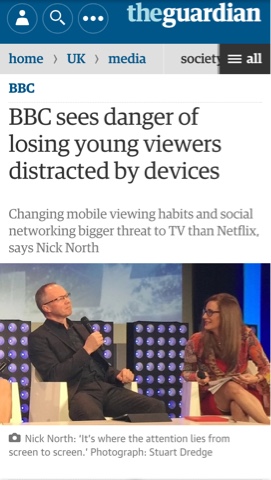
    The article outlines BBC's growing concern that they are losing younger audience groups through new devices (smart phones etc). And how thy are attempting to make BBC appeal more to the younger generation consumers - for instance, an I-player log in, which can be accessed through mobile devices - the mean in which is dissecting the BBC's younger audience. 

    Key Quotes and Facts: 
    • “What we’re thinking about is OTT: is this a threat to TV, is Netflix a threat to TV? No it isn’t. It represents a small part of what people want from TV,” said North, speaking on a panel at the Mipcom conference in Cannes.
    • “But social will grow and become the primary activity: the kid sitting there with the TV on, but they’re on their [mobile] screen. So it’s where the attention lies from screen to screen.”
    In my opinion, I think it is a wise move that BBC are looking closely at what best fits the needs of the younger generation in terms of TV, as after all they will become the older generation eventually and it is ideal that they function the accessibility toward their upcoming audience base. 

    Article from The Guardian
    The article addresses Amazon Primes' new offer to members for a six month free trial of the digital edition of the Washington Post and a discount on future subscriptions. The deal sparked intense speculation about how the power of the world’s largest online retailer would be brought to bear on one of the US’s most prestigious titles.
    Key Quotes: 
    • “Offering free access to new subscribers through Prime allows us to connect with millions of members nationwide who may not have tried the Post in the past,” said Washington Post president and general manager Steve Hills. 
    • “With this special offer, Prime members can see firsthand why more than 50 million people monthly choose the Washington Post as their source for news.”
    • Bezos’s $250m acquisition of the Washington Post brought to an end 80 years of ownership by the Graham family, which turned the paper into one of the most respected titles in the world via its series of scoops over the Watergate scandal.
    • “Offering free access to new subscribers through Prime allows us to connect with millions of members nationwide who may not have tried the Post in the past,” said Hills.
    In my opinion, I think that this is a prime example of the impact new and digital media is having on the newspaper's print industry and it is quite upsetting to see. The concept and behaviour of one commuting and buying a hand print copy of a newspaper, is far more appealing in my eyes than relying on an electronic device to attempt to offer the same thing. However, the offer of a six month free trial is appealing, but yet jeopardising for journalist and revenue sales.